Showing posts with label history. Show all posts

Sunday, May 22, 2011

Marc Chagall and the Bible

This is a beautiful exhibition. If you're in Paris, you should go.

Chagall et la Bible - Musee d'art et d'histoire du Judaisme (Hôtel de Saint-Aignan, 71, rue du Temple). Until June 5th.

Chagall was a Jewish Russian artist who spent much of his early career in France, got trapped back in Russia for the first World War, emigrated to the States for the Second, and finally settled in France afterward. He is famous for painting the ceiling of the Opéra Garnier. After the war he was invited and accepted commissions to design the stained-glass windows at not only a synagogue but also a Catholic church in Berlin. The exhibit is prints from his illustrated Bible.

Wednesday, May 18, 2011

Pays de la Loire: Land of Chateaux


I am behind, but I'll try to catch up a bit today. Last weekend EDUCO took us to Pays de la Loire to visit two chateaux - Chambord (above) and le Chateau de Blois. Since it takes decades to build one of these things, each chateau exhibits multiple architectural styles as well as the symbols (logos?) of multiple sovereigns.

Fireplace at Blois: King Salamander, Queen Ermine (François I, Anne de Bretagne)

Chambord was built as a hunting lodge in the middle of a park the size of Paris. While it is architecturally striking, it's mostly empty these days. Blois, on the other hand, remains richly decorated with paintings and furniture relating to some of the intrigues that took place at the chateau.

Above, the king's bedchamber, where Henri III had the duc de Guise assassinated after inviting him in for a private audience. According to popular legend, he died at the foot of the bed. The painting on the right depicts the scene.

Throne
Staircase at Blois, design attributed to Da Vinci; EDUCOers

Royal Seal, Ceiling of Catherine de Medici's office.

Another scandal: Henri II arranged the royal emblem so that the "H" (Henri) and "C" arranged to form the shape of a "D", for Diane de Poitiers, his mistress, who coincidentally was also 20 years older than him.

Though it was pretty spare inside, Chambord offered some great views:


Tuesday, May 10, 2011

Shakespeare & Co.


I've been putting off writing about Shakespeare and Co. until I could write something other than the standard touristy rave reviews. I'm not sure I can now, but in the name of naming something beautiful here everyday, today I'll try.

The store, which is not the same one that belonged to Sylvia Beach (publisher of Ulysses and sneaky, Nazi-evading bookstore relocator), is located between Notre Dame and the Place St. Michel on the Seine. The outside is painted green and yellow and on the shutters is a testament. Written in white on a black background (like the specials at a restaurant) in all caps, is a brief explanation of the store as told by George Whitman, the owner. The building is ancient. It used to house monks in the middle ages. Since 1951, the floors have groaned good-naturedly under two levels of floor-to-ceiling books in English. The left-hand side as you enter is the Antiquarium - first editions, signed copies, lots of leather, and that smell that every bibliophile loves. The right hand side is the merchandise - Julia Child is on permanent rotation, along with whatever new chick lit is set in Paris as well as French literature in translation. That is good business. Beyond that the store's "Poets' Corner" easily beats the poetry selection at your local Borders, and all the best contemporary writers are on their shelves.

The real power of the store is its cultural currency. It is a touchstone for lovers of the Beat Generation (of which Mr. Whitman was definitely a part). It carries on, quietly, its stalwartly bohemian tradition of allowing young writers, travelers, and book lovers to stay in the store in exchange for work. A few hours of shelving books earns you the right to sleep among them on couches on the second floor, a place where most tourists rarely venture. The store is thus staffed by shifting set of anglophone bibliophiles, some are hipsters and some just really really love reading. Joining the ranks of the "tumbleweeds," as they are called, is no easy feat, since English-speakers from New York to Cape Town dream of staying in this little Utopia. Those who are really serious about working at the shop get vetted by Sylvia. She can often be seen gliding between the shelves followed by a black dog. Sylvia is beautiful.

She has been running the shop since 2003. I imagine she grew up with her father in the apartment adjacent, where George used to hold tea on Sunday afternoons. I don't know if he still does it. He's at least 99 now. His daughter is only 30, but she has the old-school glamour one would expect from such an environment - ivory skin, short, wavy blond hair and a petite frame which she dresses becomingly in styles Katharine Hepburn would be at home in. She intimidates the hell out of me, I'm in awe of the poise and intelligence she projects just checking in with the cashiers or standing at the back of a reading.

Another thing that makes Shakespeare and Co. so great is their regular and varied readings. In 2009, I was lucky enough to see Jonathan Safran Foer read what would later be the first chapter of Eating Animals there, as well as the poets (and my teachers at the time) Joshua Beckman and Matthew Rohrer. Next week is Paul Harding and I'm dying to go. Men so talented I feel like I'll never be hungry again thinking about their work. Yeah, that's a weird reaction all right, but the excitement, and the motivation to read and write, the love of our language and the hope that maybe, with enough work, one day I could do something equally valuable -- even just the memory of it -- makes my stomach do somersaults. And that's the thing about Shakespeare and Co. The lush past filled with singed hair and traveling artists is just waiting to be reborn in the tumbleweed whose travel tales inspire a generation to reexamine their lives or the visiting writer who can finally wake up the muse that's been sleeping in the city for decades now. Here's to inspiration. Here's to holding out.

Wednesday, March 16, 2011

La Sainte Chappelle

I am currently using this blog as a study break between writing sections of my commentaire composé on a sonnet from the 16th century. So this post is mostly pictures.

Back in January, my friend Frank and I braved the ever-enormous line snaking down the sidewalk in front of the Palais de Justice on Ile de la Cité to go inside La Sainte Chappelle. Mon beau-père recommended the Gothic chapel many times before I left (and in our Skype conversations since then), saying that it had some of the prettiest stained glass windows he had ever seen. Also, Frank had a list of stuff he wanted to do before he left, and I had already bailed on ice skating at Hotel de Ville, since undoubtedly I would have run over a small child or some "racaille" would backflip right into me -- either way, smushed was going to happen --, so we put on our hats and mittens and coats (actually at that point I hadn't taken mine of in exactly 49 days, smelled fabulous) and got in line.

Here is what we saw:
Downstairs was beautiful, but much of the opulent artwork was hidden in shadows. There was some stained glass, but it was hardly something to shout (or Skype) about. I was confused about the rave reviews until we went upstairs. Absolutely stunning.


Saturday, February 5, 2011

Versailles


The chateau: A casual history (paraphrased from our tour guide)

Louis XIV hated Paris. This was probably because of the angry mob that attacked the Louvre when he was a child. And who can blame him? Angry Parisians are pretty freaking scary one on one. De plus, in what sounds like the plot of the latest Keira Knightley movie, nobles (even members of his own family!) were spending the long, electricity-less hours in their far-flung chateaux plotting to overthrow first his dad and then Cardinal Mazalan, Louis' regent after he was crowned at the ripe old age of five. So once Louis had finished puberty was deemed ready to reign, he packed up the court, sent some invitations to his dear, sweet nobles, which if read between the lines, said "Get over here and keep your hands where I can see 'em" (kind of gives a new perspective on the Hall of Mirrors, no?) And that's how everybody who was anybody relocated to Versailles, where they would live out their days fighting over who got to watch him get dressed in the morning.

Louis' great-grandson, Louis XV was very handsome, but kind of shy, and though he was the bien-aimé when he came to power, by the end of his reign he was hated. It didn't help the Bourbons' case that his successor, Louis XVI, was the royal equivalent of that awkward kid who's really smart but can't make eye contact with people and spends all his free time on antisocial hobbies. (In his case, watchmaking and locks, since this was before Magic cards and WoW). He was married to Marie Antoinette, who was a little too social. They were also like 18 when they came to power. If their coronation happened today, he would pick at his acne nervously and she would text the whole time. We all know how that story ends.

During the Revolution, villagers (Versailles is also the name of the surrounding town) defended the palace. Afterward, the various Republican regimes sold off the furniture to foreigners, and all indications of the Bourbons (i.e. suns with Louis' face in them) were removed. Various suggestions were raised for what to do with the gigantic symbol of monarchical decadence and abuse of power. These included turning into a military hospital or a factory. It was Charles X (I think) who saved it by deciding to turn the space into a museum. He only got to renovate a small part of the compound before the regime changed once again.

The French government now spends the majority of it's historical monument budget maintaining Versailles and the Louvre (la tradition = 1, le républicanisme = O). The chateau remains sparsely furnished, and many of the ornate picture frames are filled with black and white photocopies of the paintings that used to hang in them, but pieces are slowly making their way back in, and many of the frescoes (like in the chapel) and moldings have been restored perfectly.
Highlights included Louis XIV's desk, which was absolutely stunning and filled with secret drawers; the queen's bed, special occasion tableware, and a library where every inch of wallspace is covered in books and French literary geniuses look down on you while you study.

This is a door.

It took about ten years of Baroque architects, sculptors, and artists working on the chateau before Louis XIV deemed it fit for a king, and everywhere you look, inside and out, is beautiful. My camera seems to get overwhelmed in the presence of stained glass and goldleaf, so I haven't done the building justice here, but it is truly breathtaking. It's definitely the most important daytrip from Paris.

Tuesday, November 16, 2010

Barcelone


The day I arrived in Paris the weather was perfect. Then, fall came a bit late, but come it did and we are in what can only be described as hiver. That is to say yucky weather, and lots of it.

The sun comes up at 7h45 and sets at 17h30. (Oh yes, military time, just to make things exciting, the French like to switch back and forth.) In between it is mostly gray, cold, and pitifully damp. It's like the sky is so depressed it can't even be bothered to rain properly -- either that or it has a cold. It's OK, I keep telling myself, I was prepared for this, but honestly, I've been spending a lot more time on Facebook than I like to admit.

Anyway, my friend Pomegrenade (OK, the pseudonyms are getting a bit tiresome, but switching now would probably get confusing) and I were granted a reprieve from all that last weekend. We originally tried to go to Barcelona Halloween weekend, but with all the grèves, flights were cancelled. So, take two, we hoped on separate Ryanair flights de Paris à Barcelone and landed in the land of sunlight, strange architecture, and tapas.


First Impression of Spain

I arrived first, and found the hotel without trouble, pleasantly surprised to discover that Pomegrenade had wrangled a double room at the 3-star Hotel Gran Ducat for 3 nights for about 100 euro each. Nice. At first I was excited to get to speak the 10 words of Spanish I learned in my year at the Mexican restaurant, but once the concierge had established that he did not want queso with his quesadilla, we were kind of at an impasse. Eventually he just gave me a room key so I would leave him alone. The first thing I did was take a long nap. Then I found some dinner/lunch (it was only 7 p.m., after all) and walked around the square a bit.


First meal: egg and potato "tortilla," grilled veggies, and beef stuffed squid with a tomato sauce.

Our hotel had an awesome location, right next to the Plaça Catalunya, a square with a bunch of lovely statues and fountains, some great restaurants (which I'll get to in a bit) and a lot of young people, since it's near the Plaça Universitat. The square is also a block away from Las Ramblas, which seems to be the heart of Barcelona tourism with street performers, open-air pet shops, little restaurants, boutiques, etc.
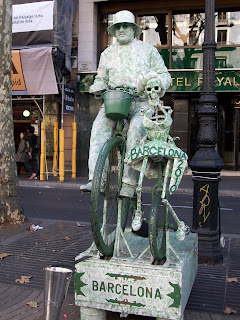
I'm getting ahead of myself. Pomegrenade got in around 10:30 p.m. and we went down to the beach to check out Barcelona's famous nightlife, which did not disappoint. We asked some very friendly policemen where to go and they directed us down to the harbor, which turned out to be a gauntlet of doormen literally trying to pull you into their clubs/restaurants/bars. We made it to the end where we sat down for a coffee to recompose before heading back through it (the only way out). Clearly, this was not where we wanted to be. So we tucked our heads and limbs where they were not easily grab-able and dashed out. At the exit, a nice Algerian guy was handing out fliers and when he heard us speaking french, befriended us and escorted us (politely, not forcefully) to a real club, Carpe Diem, which played awesome music and had a cool South Asian vibe. Almost everyone we met that night was French. Strange.

The next day, we woke up early and hightailed it to La Sagrada Familia, Gaudí's chef-d'oeuvre. Started in 1882, the massive cathedral is still under construction. (This is probably why it costs 12/10 euro for students just to get in.) The outside struck me as a little goofy, kind of like a real world construction of Whoville.


The inside, however, is mind-blowing. Walking into the clean, spacious, light-filled sanctuary, all I could think was, "Wow, how great that God outlived the Gothic period!" I don't have anything against the Gothic period, I've just seen A LOT of cathedrals in the last two months. But not like this one. It's beautiful. It is so beautiful. The stained glass, the columns, everything is so clean and un-oppressive. It has been my experience that there are two types of churches: traditional, dark-wood-marble-gold-cross churches and modern, white-walled, if-this-is-God's-house-then-he-moved-to-the-suburbs churches (more commonly "Houses of Worship"). The interior of Sagrada Familia managed to escape the stodgy, suffocating atmosphere of the first without falling into the soulless, painfully simplified style of the later.


After that we headed over to a cute medieval Spanish town where there were a lot of artisans and awesome hot chocolate. I bought a scarf and some Christmas presents.

That night we got TAPAS!! Deep fried Camembert with red berry sauce. Mini-pan of paella. Stuffed mussels. Sangria. Catalan crème brulée and "Three textures of chocolate with extra virgin olive oil and sea salt" for dessert. We considered never leaving.


Friday, our last day in the city, we walked down Las Ramblas and scouted out Gaudí's Casa Milà, which is very famous for its wavy silhouette and crazy balconies. Leaving that, we stumbled upon his other private residence, Casa Batllo, which might be less famous, but is definitely more awesome.
Casa Batllo. Some people call it "The Dragon House" because the mosaics look kind of scaly and the balconies look like bones.

That night there was more tapas, some more dancing, and a lot of Spanish MTV before our 4 a.m. wake-up call and back to Paris.

One of the best things about Barcelona was all the random wacky art. Examples:

Sunday, October 31, 2010

L'Avare à la Comedie Française


(I started this post a few weeks ago but never put it up. Sorry, Momma.)

Last weekend Educo took a group of us to La Comedie Française, which is housed in the Palais Royal, a smaller complex across the street from the Louvre. It's where Louis XIV grew up and later where Molière put on most of his plays. For that reason, the house troupe continues to specialize in Molière.

L'Avare tells a story about a miser who manages to ruin the love lives of his two children in the space of about five minutes. The lovers then spend the rest of the play scheming to get their father to change his mind. They fail, but, like most (all?) Molière plays, there's a happy ending anyway -- call it Louis ex machina.

Educo gave us all copies of the play to read our first week in France but not many people got through it. It wasn't a problem though because swooning translates pretty well.

Saturday, October 30, 2010

Spooky Paris


Last week, Le Chef and our new friend, Pomegrenade, and I had picnic, and since it was a beautiful day and we had nowhere to be, (Class was cancelled due to the grèves, it's getting to be a Thursday routine.) we decided to head over to the Catacombs. Apparently, in peak tourist season and on the weekends, the line to get in is epouvantable (horrific), but we got there right before it closed and I guess everyone else was at the manifestation. We paid our student price of 4euro and waltzed right in. We were just about the only ones down there, and it might have been the first time I missed the tourist hoard.

After paying, you are directed to a staircase. Imagine how spacious it would be if someone decided to put a spiral staircase in a manhole. Now imagine that said manhole goes at least five stories down. Now imagine that you and your two friends are the only ones down there. Once you reach the bottom of the staircase and recover from the vertigo, there are a couple kilometers (yeah, I just went metric) of chalky, strangely lit, unmarked corridors. My friends took this opportunity to make up tag lines for the horror movie that would be made of our story: "In October 2010, three exchange students in Paris went sightseeing...their bodies will remain in the tunnels forever," etc.

Finally, we arrived at the entrance:

(STOP! THIS IS THE EMPIRE OF DEATH)

The French government has always had a flair for the dramatic, no? The Catacombs were created in the 1750's (I believe) to ameliorate the public health problems caused by overcrowded cemeteries in Paris. Ew. Thousands of disgusting old corpses were dug up as part of what has to be the worst temp job ever. The last bodies were moved in around 1820. The bones are stacked in extremely compact, orderly rows that give the distinct impression that when French people die, they disintegrate until nothing remains but skulls and femurs.


The most interesting part of the visit to me was the signage. Apart from lots of Latin and crosses and signs indicating where particular femurs had first been laid to rest, there was a lot of poetry:


(Come people of the world, come into these silent dwellings and you soul, now tranquil, will be struck by the voice that rises from their interior. "It is here that the greatest of teachers, the tomb, holds his school of truth.")

Happy Halloween!

Monday, October 11, 2010

Mont Saint Michel


Our second day in Normandy started off with a beautiful sunrise over our questionable hotel:

The it was back in the bus for another hour. We stopped to take pictures once the church came into view, and while we were off the bus we ran into some hunters who had bought some ducks to train their new spaniels and a shepherd:


Finally, we arrived at the immense fortress/monastery and our tour guide, Gilles, took pains to describe every last type of arch and differentiate the various centuries' architecture.


Back in the day, Louis IX called it a merveille, but I think that had more to do with getting the building to stay put on top of the rock. The edifice is immense and pretty austere (as is befitting a monastery, I guess) but there were some very nice touches in the garden and windows of the refectory.


The view was beautiful, but I couldn't capture it through the fog. Besides being very Wuthering Heights, the vast panorama and shifting tides definitely give the rock strategic value, which is why everyone from William the Conqueror and to Patton has used to defend their hold on the mainland.